 Back to Blog Home
Architecting Resilient 3-Tier Applications with Sovereign Cloud DBaaS
By
Cloud Product Team • 5 min read •May 14, 2026


Overview
Modern applications demand scalability, resilience, and operational simplicity. The traditional 3-tier architecture comprising presentation, application, and database layers remains a foundational design pattern. However, with the rise of Database as a Service (DBaaS), this architecture has evolved significantly to improve availability, reduce operational overhead, and enhance reliability.
SITE Cloud provides DBaaS with both Sovereignty and High Availability
Role of DBaaS in Modern Architecture
DBaaS abstracts database operations such as:
• Provisioning and configuration
• Backups and recovery
• Patch management
• Replication and failover
• Scaling storage and compute
This allows engineering teams to focus on application logic instead of database administration.
High Availability in DBaaS
High availability ensures that the database remains accessible even during failures. DBaaS platforms typically achieve this using:
• Automatic failover
• Synchronous replication
• Multi Region Deployment (Optional)
If the primary database node fails, a standby node is automatically promoted with minimal downtime.
Architecture: 3-Tier with DBaaS HA
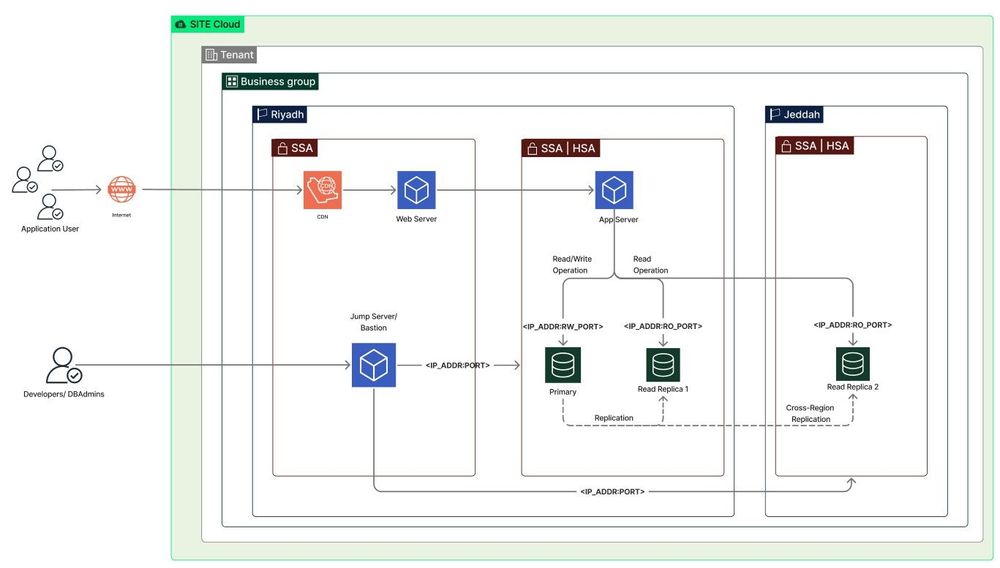
Developers / DBAdmins can connect to the Primary or Replica through client utility like pgAdmin or pgsql CLI using the Shared IP and port no through Jump server/bastion.
Flow in High Availability Setup
1. User request reaches frontend
2. Request is processed by application layer
3. Application connects to DBaaS endpoint
4. DB writes go to primary node
5. Reads may go to replicas
6. If failure occurs:
o Standby node is promoted automatically
o Application reconnects seamlessly
Key High Availability Design Principles
1. Multi- Region Deployment
DB nodes are distributed across different regions to avoid single points of failure.
2. Automatic Failover
If the primary node becomes unavailable:
• Standby node is promoted automatically
• Applications reconnect to new primary using Load Balancer
3. Read Scaling with Replicas
• Read-heavy workloads are offloaded to replicas
• Improves performance without impacting primary node
How DBaaS Improves the 3-Tier Model
Before DBaaS (Traditional Setup)
• Manual replication setup
• Complex failover scripts
• High operational burden
• Slow recovery times
With DBaaS
• Built-in HA and replication
• Automated failover
• Managed backups and patching
• Faster provisioning (minutes instead of days)
Benefits of 3-Tier Architecture with DBaaS HA
• Reduced operational complexity
• Higher availability and fault tolerance
• Faster application delivery
• Scalable read/write workloads
• Compliance-ready architecture (especially in sovereign cloud setups)
Date Sovereignty
In sovereign environments, DBaaS must also ensure:
• Data residency within a specific country
• Localized control plane operations
• Compliance with regulatory frameworks
• Build In Security Controls
This ensures high availability does not compromise sovereignty requirements.
Conclusion
Integrating DBaaS into a 3-tier architecture significantly enhances system resilience and operational efficiency. High availability is no longer a complex engineering challenge it becomes a built-in capability of the database platform.
For modern enterprises, especially in regulated or sovereign environments, this architecture provides the right balance of scalability, reliability, and compliance.
As systems continue to evolve toward cloud-native and distributed models, DBaaS will remain a foundational pillar of high availability architectures.